.png)
What Should a CFO Ask Before Buying an AI Analytics Tool?
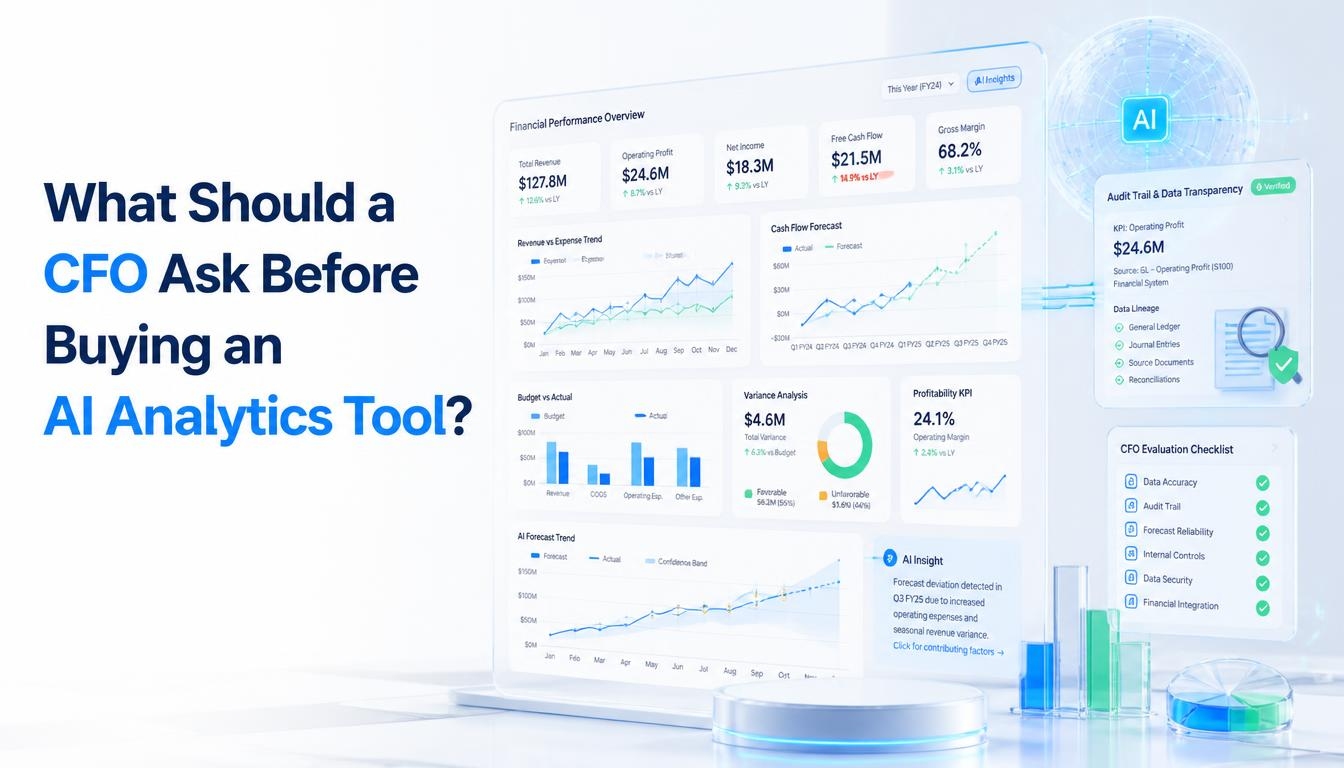
Every AI finance vendor demo looks impressive clean dashboards, instant variance explanations, a forecast that updates itself. What the demo rarely shows is what happens when an auditor asks where a number came from, or when a forecast swings 15% and the board wants to know why. Buying an ai tool for cfo financial reporting isn't really a software decision; it's a controls decision, and the questions that matter most are the ones vendors don't volunteer answers to unasked.
Why This Purchase Decision Is Different From Other Software
Most departmental software failures are inconvenient. A finance reporting failure is a compliance event. Every output a CFO's team produces board decks, audit schedules, SEC filings has to be defensible down to the source transaction, which means an AI tool that produces impressivelooking numbers without a clear trail back to the general ledger isn't actually usable in a finance function, no matter how accurate it claims to be.
Question One: Can Every Output Be Traced Back to Source Data?
This is the single most important question, and it's the one demos are least likely to answer unprompted. Ask the vendor to show live, not in a slide how a summary number on a dashboard drills down to the specific transactions behind it. Traceable financial reporting ai should let a controller click from a variance explanation straight to the journal entries driving it, the same way they could in a manual reconciliation, just faster.
Question Two: What's Actually Driving the Forecast?
Ai forecasting finance tools are only useful if the CFO's team can explain a forecast to the board, not just present it. Ask the vendor to show what happens when a forecast changes significantly between periods: can the tool name the specific variables a slipping renewal, a changed cost assumption, a seasonal pattern that moved the number? A forecast that can't explain its own swings will erode trust with the board the first time reality diverges from the model.
Question Three: What Does the Audit Trail Actually Look Like?
Ask specifically who can change an assumption or override a model output, whether every change is logged with a user and timestamp, and whether that log is something an external auditor could review directly. Vague answers about "enterprisegrade security" without a concrete audit log are a signal the product wasn't built with finance controls as a first requirement.
Question Four: How Does the Tool Handle a Bad Data Month?
Every company has a quarter with a oneoff adjustment, a restated prior period, or a data feed that broke for a week. Ask how the tool flags and handles anomalous or missing data rather than silently forecasting on top of it a tool that quietly extrapolates from bad data will produce a confidently wrong forecast, which is worse than no forecast at all.
Questions That Separate Ready Vendors From Risky Ones
Question Area | Red Flag Answer | Answer You Want |
Traceability | "Trust the model" with no drilldown to source ledger entries | Every output links back to the underlying transactions |
Forecast methodology | Cannot explain what drives a forecast change month to month | Clear list of the variables and assumptions behind each forecast |
Audit and controls | No audit log of who changed what, or vague compliance claims | Documented audit trail and named compliance certifications |
A vendor that answers all three areas with specifics, live in the demo, is worth a deeper evaluation. A vendor that redirects to marketing language on any one of them is worth pausing on, regardless of how polished the rest of the platform looks.
Running the Evaluation Without Slowing Down the Decision
1. Bring a Real Close Cycle Into the Demo
Ask the vendor to run their tool against a recent, real close package rather than their own sample dataset, so the traceability and anomalyhandling questions get tested against your actual data quality.
2. Involve the Controller, Not Just the FP&A Team
Forecasting value and auditreadiness are evaluated differently. The controller's team should sign off on the traceability and audit trail before the decision is finalized, not after implementation begins.
3. Pilot on One Reporting Area First
Rather than rolling the tool out across every report at once, pilot it on a single recurring report monthly variance analysis is a common starting point to validate accuracy and traceability before expanding scope.
Frequently Asked Questions
What is an AI tool for CFO financial reporting, exactly?
It's software that applies machine learning to close, consolidate, and analyze financial data automating variance analysis, flagging anomalies, and generating forecasts while still producing reporting that ties back to the general ledger the way a finance team's existing controls require.
Why does traceability matter more in finance than in other AI use cases?
A marketing dashboard being slightly off is a minor inconvenience. A financial report that can't be traced back to its source transactions is an audit and compliance problem, which is why traceable financial reporting ai is a requirement for finance teams in a way it isn't for most other departments.
How is AI forecasting finance different from a traditional budget model?
A traditional budget model typically updates on a fixed cycle using assumptions set manually by finance. AI forecasting finance tools continuously reforecast as new transaction and operational data arrives, and can flag which specific variables are driving a forecast change rather than requiring an analyst to rebuild the model by hand.
Should a CFO expect the AI to replace the finance team's judgment?
No. The realistic role of these tools is to handle the data aggregation, anomaly detection, and firstdraft forecasting so the finance team spends its time interpreting results and making calls, not manually reconciling spreadsheets.
What's a reasonable timeline to see value after implementation?
Most finance teams see value on recurring tasks like variance analysis and close automation within one to two reporting cycles, while forecasting accuracy typically improves gradually over two to four quarters as the model learns the company's specific patterns.
How should a CFO evaluate vendor claims about accuracy?
Ask for accuracy figures broken down by the specific line items or forecast types relevant to your business, not a single blended number, and ask how the vendor measures accuracy against your own historical actuals rather than a generic benchmark.
Conclusion: Ask the Questions Before You're Answering to an Auditor
The right ai tool for cfo financial reporting saves real time on close and forecasting, but only if it was built to the standard finance actually operates under. Traceable financial reporting ai and honest, explainable ai forecasting finance aren't nicetohaves layered on top of a good product they're what makes the product usable in a finance function at all. Ask the hard questions in the demo, not after the contract is signed.
Evaluating a vendor now? Bring your last close package to the next demo and watch how the tool handles it.