.png)
What Is SDAIA? A Guide to Saudi Arabia is Data & AI Authority
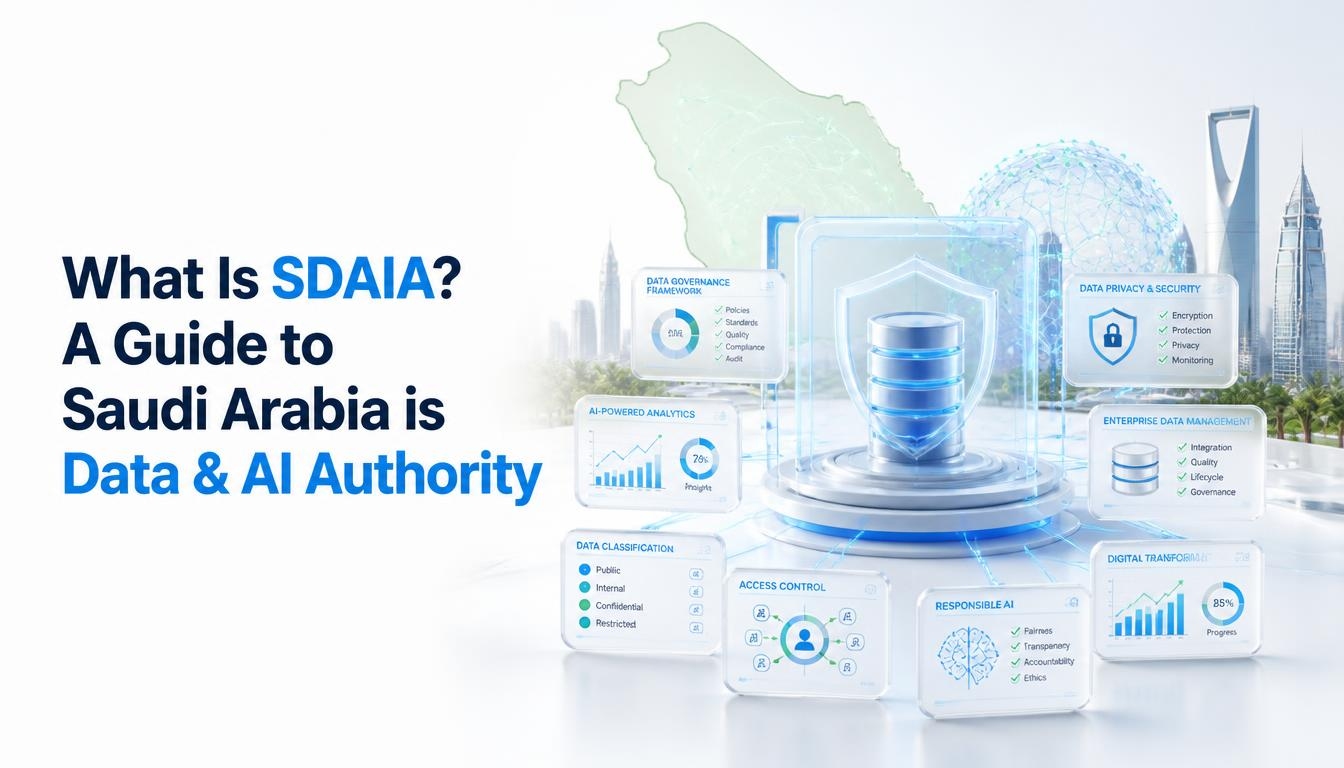
Saudi Arabia has named 2026 the Year of Artificial Intelligence, and one organization sits at the centre of that push: SDAIA. If your business runs dashboards, machine learning models or any data driven product in the Kingdom, SDAIA is rules shape how you collect, analyse and act on data. This guide explains what SDAIA is, what it regulates, and what SDAIA compliant analytics looks like in practice, so you can build insight without building regulatory risk.
What Is SDAIA?
SDAIA is the Saudi Data and Artificial Intelligence Authority, the national body that leads the Kingdom is data and AI agenda. In Arabic it is known as هيئة البيانات والذكاء الاصطناعي. It was established in 2019 and is chaired by Crown Prince and Prime Minister Mohammed bin Salman, which shows how central data and AI are to Saudi Vision 2030.
For businesses, SDAIA Saudi Arabia plays two roles at once. It is a builder, developing national AI capability, platforms and talent. It is also a regulator, issuing the data governance policies, ethics principles and enforcement decisions that organizations must follow. Understanding both roles is the first step towards compliant analytics.
The pace is accelerating. In March 2026 the Saudi Cabinet designated 2026 as the Year of Artificial Intelligence, and SDAIA followed with guidelines setting out the objectives of the initiative. For organisations, that means more attention on AI adoption, and more scrutiny of how it is done.
What Does SDAIA Do?
SDAIA is work is organised around three main bodies, plus a national strategy that ties them together.
The Three Arms of SDAIA
• National Data Management Office (NDMO): the regulatory arm. It sets data governance policies and standards and monitors how organizations follow them.
• National Center for Artificial Intelligence (NCAI): the research and solutions arm. It develops AI solutions, advises government on AI strategy and promotes AI education and awareness.
• National Information Center (NIC): the operational arm behind national data infrastructure and government digital services.
The National Strategy for Data and AI
Issued in 2020, the National Strategy for Data and AI (NSDAI) sets out how the Kingdom intends to become a global leader in AI by 2030. It links SDAIA is regulatory work to Vision 2030 is economic goals, which is why new guidance on ethics, data governance and AI adoption keeps arriving alongside investment in skills and infrastructure.
Saudi AI Regulation: How the Rules Fit Together
A common question is whether there is a single AI law. Based on recent legal surveys, Saudi Arabia does not currently have a standalone, AI specific statute. Instead, Saudi AI regulation works in layers, and it pays to understand which layer is binding.
Binding Data and Cyber Laws
The Personal Data Protection Law (PDPL) and national cybersecurity requirements apply to AI systems because AI runs on data. These are the enforceable rules. If your models use personal data, the PDPL applies whether or not the word "AI" appears in it.
SDAIA is AI Guidance
SDAIA has issued three main AI instruments: the AI Ethics Principles (September 2023), the Generative AI Guidelines (January 2024) and the AI Adoption Framework (2024). The ethics principles cover seven areas: fairness, privacy and security, humanity, social and environmental benefits, reliability and safety, transparency and explainability, and accountability and responsibility. They apply across the AI lifecycle to both public and private sector stakeholders.
Legal commentary describes these documents as guidance rather than rules that carry fines. Even so, SDAIA monitors adherence to the ethics principles, and they set the standard that clients, partners and regulators tend to measure your AI against.
Sector Regulators and What Is Coming
Sector regulators add their own expectations on top, for example in finance, health and public administration. You may also hear about the draft Global AI Hub Law, which the Communications, Space and Technology Commission put out for consultation in 2025. It deals mainly with hosting foreign data inside the Kingdom rather than regulating AI systems in general. Because this area moves quickly, check for updates before you finalise any compliance plan.
[INTERNAL LINK: Saudi AI regulation cluster post | suggested anchor text: saudi ai regulation]
PDPL and Data Governance: The Rules With Teeth
The PDPL is Saudi Arabia is first comprehensive data protection law. It entered into force on 14 September 2023, and organizations had a one year grace period that ended on 14 September 2024. It applies to processing inside the Kingdom and to organizations abroad that process the personal data of people in the Kingdom. SDAIA is the initial competent authority for enforcement, with supervision possibly moving to the NDMO later.
The penalties are significant. Fines can reach SAR 5 million and may be doubled for repeat violations, and certain unlawful disclosures of sensitive data can lead to imprisonment of up to two years. Individuals can also complain to SDAIA, generally within 90 days of an incident.
Enforcement is no longer theoretical. According to a compliance industry summary of SDAIA is announcement, its enforcement committees issued 48 formal decisions in 2025. Recurring problems included processing personal data without a lawful basis and weak transparency towards individuals. For analytics teams, both are easy to trip over when data collected for one purpose gets reused for another.
Alongside the PDPL, the NDMO publishes data governance policies and standards that fill in the detail. These include general standards for transferring personal data outside the Kingdom, a policy on the privacy of children and others who lack legal capacity, and guidelines on data management governance and personal data security. Analytics teams should treat these as part of the same compliance picture rather than separate exercises.
[INTERNAL LINK: PDPL / data protection cluster post | suggested anchor text: sdaia saudi arabia]
What Is SDAIA Compliant Analytics?
SDAIA compliant analytics means designing your data collection, analysis and AI models so they meet PDPL obligations, follow NDMO data governance expectations and reflect SDAIA is AI ethics principles. There is no single badge that makes analytics compliant. It is a set of practices you can evidence if a regulator or client asks.
The practices below are a good starting checklist.
Practice area | What SDAIA compliant analytics looks like |
Lawful basis and purpose | Document why you process each dataset and use it only for the purpose you declared. |
Minimisation and retention | Collect only what the analysis needs, set deletion schedules, and anonymise or pseudonymise where you can. |
Transparency and rights | Publish clear privacy notices, record consent where it is your legal basis, and have a process for data subject requests. |
Cross border transfers | Map where data is hosted and analysed, and check the transfer rules before personal data leaves the Kingdom, including through cloud tools. |
Security | Apply access controls, encryption and an incident response plan to analytics environments. |
AI ethics | Test models for bias, be able to explain outputs, and name an accountable owner for each model. |
Generative AI use | Keep human review in place, avoid pasting personal or sensitive data into unapproved tools, and follow SDAIA is guidance on oversight and content authenticity. |
Getting this right does more than reduce enforcement risk. Clear records of why and how you process data can also make procurement, audits and partner due diligence much smoother, because you can show your work instead of assembling it under pressure.
This table is a practical summary, not legal advice. Confirm your specific obligations with qualified Saudi counsel.
How to Get Started With SDAIA Compliant Analytics
1. Map your data. List your data sources, where the data is stored and processed, and who can access it.
2. Identify personal and sensitive data. Record the lawful basis and purpose for each dataset.
3. Review vendors and cloud tools. Check hosting locations, transfer arrangements and security controls.
4. Build ethics checks into model work. Add bias testing, documentation and human oversight to your development process.
5. Assign ownership. Name the people responsible for data protection and AI governance.
6. Keep it current. Revisit your controls as SDAIA guidance and the PDPL regulations evolve.
[INTERNAL LINK: sibling cluster post on compliant analytics workflows | suggested anchor text: sdaia compliant analytics]
Frequently Asked Questions
What does SDAIA stand for?
SDAIA stands for the Saudi Data and Artificial Intelligence Authority (هيئة البيانات والذكاء الاصطناعي in Arabic). Established in 2019, it leads Saudi Arabia is national data and AI agenda and acts as both an enabler and a regulator.
Is SDAIA the same as NDMO?
No. The National Data Management Office (NDMO) is SDAIA is regulatory arm for data governance. SDAIA is the wider authority that also includes the National Center for Artificial Intelligence and the National Information Center.
Does Saudi Arabia have an AI law?
Not a standalone, AI specific one, according to recent legal surveys. Saudi AI regulation works through binding data and cybersecurity laws such as the PDPL, SDAIA is AI ethics and generative AI guidance, and sector regulators. The draft Global AI Hub Law covers data hosting rather than AI systems in general.
Who has to comply with the PDPL?
The PDPL applies to organizations that process personal data in Saudi Arabia, and to organizations outside the Kingdom that process the personal data of individuals located in it.
What are the penalties for breaching the PDPL?
Fines can reach SAR 5 million and may be doubled for repeat violations. Certain unlawful disclosures of sensitive data made to harm someone or gain a benefit can carry up to two years imprisonment. SDAIA can also issue warnings and corrective action orders.
Do SDAIA is AI guidelines apply to private companies?
SDAIA is AI Ethics Principles are designed to apply to public and private sector stakeholders across the AI lifecycle. They are guidance rather than directly fineable rules, but SDAIA monitors adherence and they are a useful benchmark for showing responsible AI practice.
Conclusion
SDAIA is both the engine behind Saudi Arabia is AI ambitions and the authority that decides how data may be used to get there. The PDPL is the enforceable core, SDAIA is AI guidance sets the expectations around it, and sector rules fill in the gaps. Teams that map their data, document their reasons for processing it and build ethics into their models are well placed to deliver SDAIA compliant analytics with confidence.
Ready to review your analytics against SDAIA and PDPL requirements? Get in touch with our team to start the conversation.
[CTA LINK: add your contact / consultation page URL here]