.png)
What Is Natural Language Business Intelligence?
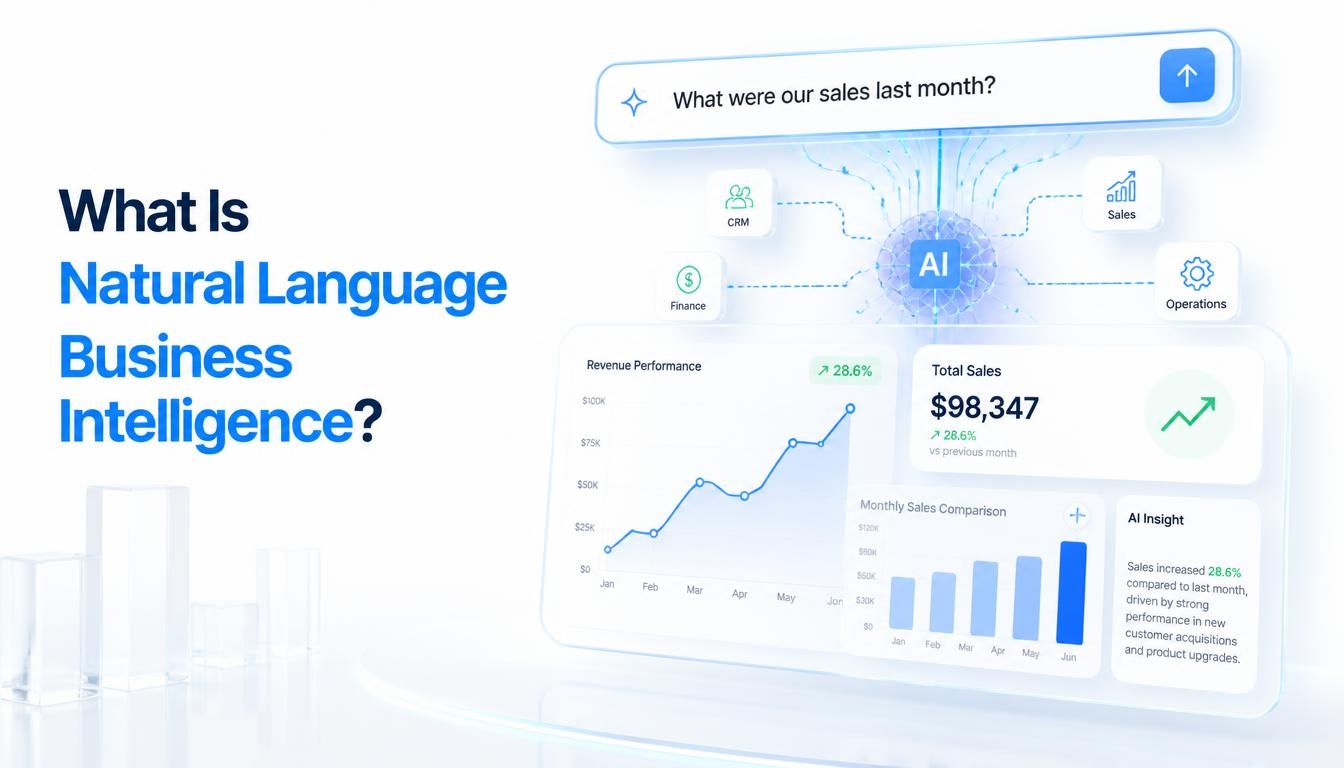
Ask a business question today and you often wait days for the answer. You message an analyst, they write a query, build a chart, and by the time it reaches you the moment to act may have passed. What if you could type the question the way you would ask a colleague and see the answer in seconds? That is the promise of natural language business intelligence.
This guide explains what natural language business intelligence is, how it works behind the scenes, how it differs from traditional BI, and where it delivers value. It also covers what to look for when evaluating tools, so you can separate genuine capability from hype.
What Is Natural Language Business Intelligence? A Plain English Definition
Natural language business intelligence (often shortened to natural language BI) is a form of business intelligence that lets people explore data and get insights by asking questions in everyday language, typed or spoken, instead of writing SQL, building formulas or clicking through dashboard filters.
For example, a sales manager could type, "Which product category had the biggest drop in sales last quarter?" and receive a chart, a short explanation and the option to ask a follow up such as, "Break that down by region." No query language and no ticket to the analytics team.
You will hear several related terms. Natural language querying (NLQ) describes the technical capability of turning questions into data queries. Conversational analytics describes the chat style experience built on top of it. And "ask your data AI" is a popular shorthand for tools that let anyone question their business data as if they were talking to a knowledgeable analyst. The common goal is self service: putting answers in the hands of the people who need them.
Why is this gaining attention now? Companies collect more data than ever, yet most employees cannot write SQL, and dashboards multiply faster than anyone can maintain them. Advances in language models have also made it practical for software to understand loosely worded questions. Together, these trends have moved natural language BI from a niche feature to a core expectation of modern analytics platforms.
How Natural Language Business Intelligence Works
Under the hood, a natural language BI tool performs several steps in a fraction of a second. Understanding them makes it easier to judge how reliable a given product will be.
Understanding the question
Natural language processing and large language models interpret what you typed. They identify the metric you care about (sales), the dimensions to slice it by (product category), the time frame (last quarter) and the intent (find the biggest drop).
Connecting the question to your data
The tool needs to know what your business terms mean. A semantic layer, sometimes called a business glossary or metrics layer, maps everyday words such as "revenue" or "active customer" to specific tables, fields and calculation rules. Without it, two people asking about the same metric could get different answers.
Generating the query and the answer
The system converts the question into a query, runs it against your data, and returns the result as a chart, table or written summary. Because the experience is conversational, the tool keeps context, so follow up questions build on previous answers rather than starting over.
Here is the flow in practice. A marketing lead asks, "How did email conversions change compared with last month?" The tool recognizes the metric and time periods, applies your definition of a conversion, queries the data, and displays a comparison chart with a one line summary. If the lead then asks, "Was the drop the same for new and returning customers?" the tool reuses that context and refines the result.
Natural Language BI vs. Traditional BI
Natural language BI does not make dashboards obsolete. Dashboards remain excellent for tracking recurring KPIs. The difference is how you get to answers that no one built a dashboard for.
Aspect | Traditional BI | Natural language BI |
How you ask | Dashboards, filters or requests to analysts | Plain language questions |
Who can use it | Analysts and trained users | Any business user |
Speed to answer | Depends on existing dashboards or analyst queue | Seconds for questions covered by connected data |
Flexibility | Limited to prebuilt views | Ad hoc questions and followups |
Setup needs | Dashboard design and maintenance | Strong metric definitions and access controls |
Key Benefits for Business Teams
Organizations adopt natural language business intelligence for a handful of practical reasons:
• Faster answers: questions that once took days can be answered in the same meeting.
• Wider data access: people in sales, finance, marketing and operations can explore data without technical training.
• Smaller analyst backlog: routine requests move to self service, freeing analysts for highervalue work.
• Better exploration: follow up questions make it natural to dig from a headline number to its cause.
• Consistent definitions: when tools are built on a shared semantic layer, everyone works from the same metrics.
These benefits depend on setup quality. A natural language interface on top of messy or poorly defined data will simply produce confusing answers faster.
Common Use Cases by Business Function
Natural language BI is useful wherever people have recurring questions about numbers. Here are typical examples:
Function | Example question | What it enables |
Sales | Which regions are behind quota this month? | Quicker pipeline reviews |
Finance | How did operating expenses compare to budget last quarter? | Faster variance analysis |
Marketing | Which channel drove the most leads last week? | Rapid campaign adjustments |
Operations | Which suppliers had the most late deliveries this year? | Proactive supplier management |
Customer support | What were the top ticket categories this week? | Earlier detection of recurring issues |
Notice that none of these questions require technical vocabulary. They mirror how managers already talk about performance in meetings, which is exactly why natural language interfaces tend to see faster adoption than tools that require learning a new query syntax.
To explore related topics, read our guides on [Internal link: natural language query (NLQ) explained → cluster post URL], [Internal link: self service analytics → cluster post URL] and [Internal link: semantic layer in BI → cluster post URL].
How to Choose Conversational Analytics Software
The market for conversational analytics software is growing quickly, and many products look similar in a demo. The real differences appear when you test with your own data and your own questions.
What to look for
• Transparency: the tool should show how it interpreted the question and how the answer was calculated.
• Semantic layer support: you need a place to define metrics, synonyms and business rules once and reuse them.
• Data connectivity: native connections to your data warehouse, databases and business applications.
• Security and permissions: answers must respect existing access rules, including row level and role based controls.
• Conversation and context: support for follow up questions and easy sharing of results.
• Integrations: availability where people already work, such as Slack, Microsoft Teams or embedded in your apps.
Common challenges to plan for
• Ambiguous questions: words like "best" or "recent" can mean different things, so good tools ask clarifying questions.
• Inconsistent metric definitions: clean up conflicting definitions before rollout.
• Trust and verification: AI can produce plausible but incorrect answers, so validate results on high stakes decisions.
• Data privacy: confirm how your data is processed and stored, especially when third party AI models are involved.
• Adoption: people need examples of good questions to get started.
A practical way to evaluate is to run a pilot. Choose one well modeled dataset, collect twenty real questions from business users, and measure how many the tool answers correctly and clearly. That test tells you more than any feature checklist.
Frequently Asked Questions
What is natural language business intelligence in simple terms?
Natural language business intelligence is a type of BI that lets you ask questions about your data in everyday language, typed or spoken, and get charts, numbers and summaries back without writing SQL or building a dashboard.
How is natural language BI different from a general AI chatbot?
A general chatbot answers from its training data, while natural language BI queries your own governed business data and returns results based on it. The answers depend on your connected data sources, metric definitions and access permissions.
What is conversational analytics software?
Conversational analytics software is a tool with a chat style interface that lets users ask questions about their data, then follow up with related questions in the same thread. It is the software category most closely tied to natural language business intelligence.
Are ask your data AI tools accurate?
Accuracy depends on data quality, clear metric definitions and how well the tool is configured. The better tools show how an answer was calculated, and important decisions should still be verified against a trusted source.
Do I need technical skills to use natural language BI?
Business users do not need technical skills to ask questions. Data teams, however, usually need to connect data sources, define metrics and set permissions so the answers are consistent and secure.
Will natural language BI replace data analysts?
No. It handles routine questions so analysts can spend more time on data modeling, governance and deeper analysis that needs human judgment.
Conclusion
Natural language business intelligence brings data closer to the people who make decisions. By letting anyone ask questions in plain English, it shortens the path from curiosity to insight and frees analysts to focus on work that needs their expertise. Success depends on solid data foundations, clear metric definitions and a careful pilot before broad rollout.
Ready to make your data easier to ask? [CTA: Explore our BI and analytics services / Contact us → link] and see how conversational analytics can fit your team.