.png)
What Is Data Governance? A Practical Guide for Analytics Teams
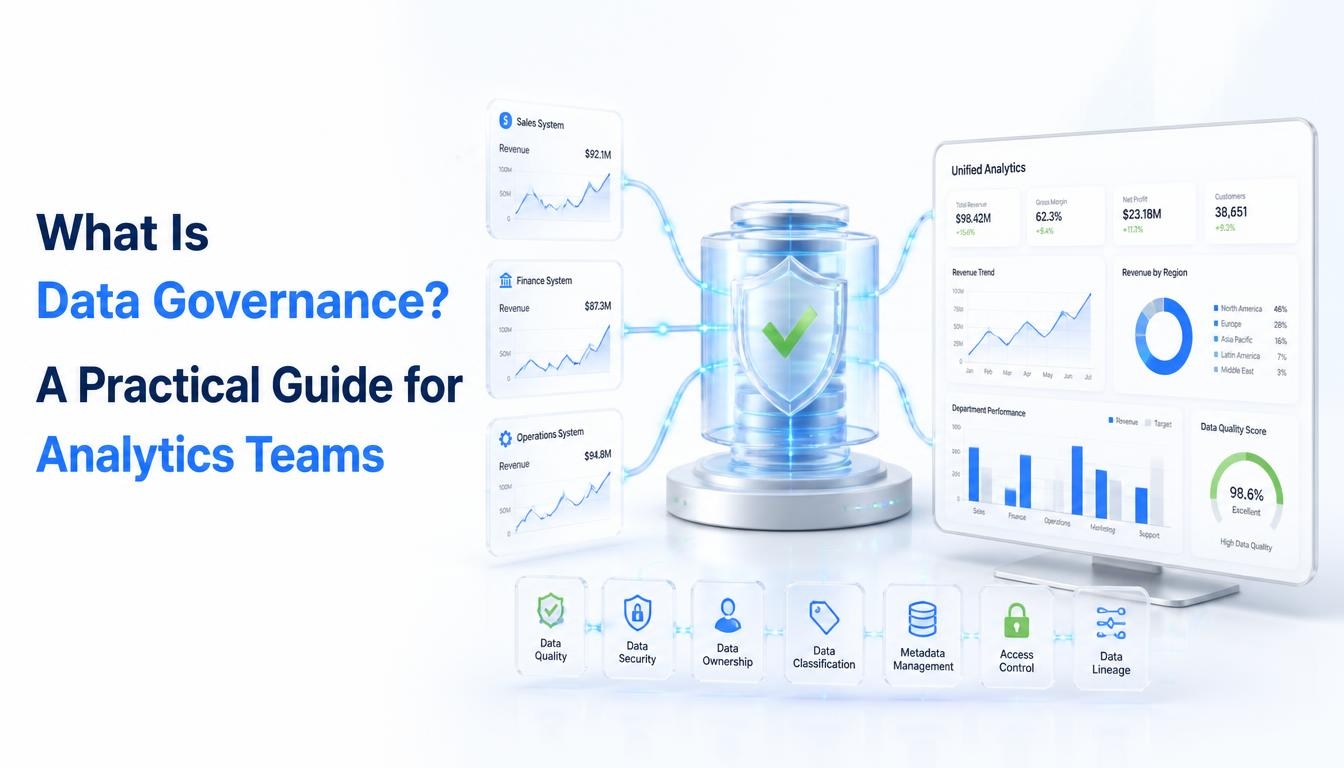
Every analytics team has lived this moment: two dashboards show two different revenue figures, and the meeting turns into an argument about whose data is right. That argument is a governance problem, not an analytics problem. If you have ever asked yourself what is data governance and whether your team needs it, the short answer is yes, and it is more practical than the term suggests.
This guide explains what data governance is, why it matters for analytics work, the components of a working framework, how it scales into enterprise data governance, and what to look for in data governance software.
What Is Data Governance?
Data governance is the set of roles, policies, standards, and processes that decide how an organization is data is defined, owned, protected, and used. In plain terms, it answers four questions: who owns this data, what does it mean, who can use it, and how do we know it can be trusted?
It helps to separate governance from its neighbors:
• Data governance sets the rules and the accountability.
• Data management carries out those rules through the daily work of storing, integrating, and maintaining data.
• Data security protects data from unauthorized access and loss. It is one part of governance, not the whole of it.
Consider a simple example. Sales and finance both report monthly revenue, but sales counts signed contracts while finance counts invoiced amounts. Both numbers are correct by their own definitions, yet the business sees two answers. Governance resolves this by agreeing on one official definition of revenue, naming an owner for it, documenting it in a glossary, and labeling any alternative measures clearly. The analytics team can then build dashboards once, on definitions everyone accepts.
Governance is not a tool, a one off project, or a locked down warehouse. It is an operating model that people actually follow.
Why Data Governance Matters for Analytics Teams
Analytics teams feel the cost of weak governance first, because they sit between raw data and business decisions. Good governance pays off in several ways:
• Trusted numbers. Agreed definitions for metrics such as revenue, active customer, or churn end the debates over whose figure is right.
• Faster analysis. When datasets are documented and owned, analysts spend less time hunting for sources and cleaning surprises.
• Regulatory compliance. Rules such as the GDPR and Saudi Arabia is Personal Data Protection Law expect organizations to know what personal data they hold and how it is used.
• Readiness for self service and AI. Self service BI and machine learning amplify data problems. Poorly defined or low-quality data leads to confident but wrong outputs.
• Clear accountability. When something breaks, everyone knows who fixes it.
Related reading: [INTERNAL LINK: cluster post on why data governance matters for AI and analytics]
The Core Components of a Data Governance Framework
A workable framework does not need to be heavy. Most successful programs combine three building blocks.
Roles and Ownership
Accountability is the heart of governance. Typical roles include:
• Data owner: a senior person accountable for a data domain, such as customer or finance data.
• Data steward: a subject matter expert who maintains definitions, quality rules, and documentation day to day.
• Data custodian: the technical team that stores, secures, and moves the data.
• Data consumers: analysts and business users who follow the rules and report issues.
Policies, Standards, and Data Quality
Policies set expectations for how data is classified, retained, shared, and named. Data quality rules turn those expectations into checks, such as completeness, validity, and freshness, with a clear process for logging and resolving issues.
Metadata, Lineage, and Access Control
A business glossary records what each term means. A data catalog helps people find datasets. Lineage shows where data came from and what depends on it, which makes impact analysis and audits far easier. Access controls, such as role based permissions and masking of sensitive fields, ensure the right people see the right data.
Go deeper: [INTERNAL LINK: cluster post on data governance roles and responsibilities]
Enterprise Data Governance: Scaling Beyond One Team
A single team can govern its own datasets with a shared glossary and a few agreed rules. Enterprise data governance connects many teams, systems, and business units under common principles, with clear escalation when they disagree. Three operating models are common:
Model | How it works | Best for | Watch out for |
Centralized | A central group sets and enforces all rules. | Smaller or heavily regulated organizations. | Bottlenecks and distance from business context. |
Federated | Business domains own governance and follow shared standards. | Large, diverse organizations with strong domain expertise. | Inconsistent practices if standards are weak. |
Hybrid | A central team sets policy and tooling; domains own execution. | Most growing enterprises. | Unclear role boundaries between center and domains. |
Whichever model you choose, executive sponsorship and a governance council that can settle disputes are what keep enterprise data governance from stalling.
Choosing Data Governance Software
Data governance software does not create governance, but it makes policies visible and enforceable at scale. When comparing products, look for:
• Catalog and business glossary so people can find and understand data.
• Lineage across warehouses, pipelines, and BI tools.
• Data quality monitoring with alerts and issue tracking.
• Policy and access management aligned with your security and privacy requirements.
• Stewardship workflows for approvals, reviews, and issue resolution.
• Integrations with the cloud platforms, databases, and analytics tools you already use.
Useful questions to ask vendors: How does the tool capture metadata automatically? Can non technical stewards use it without engineering help? How does it support your regional data residency and privacy requirements?
Start with your process and roles, then choose data governance software that fits them. Buying a tool first often ends with an expensive product that nobody uses.
Comparing options? [INTERNAL LINK: cluster post on how to evaluate data governance software]
A Practical Roadmap to Get Started
1. Pick a high value starting point. Choose one domain, such as revenue or customer data, where poor quality causes visible pain.
2. Name owners and stewards. Make accountability explicit and give people time to do the work.
3. Agree on critical definitions. Document the metrics and terms that matter most in a shared glossary.
4. Set quality rules and a baseline. Measure where you are today so you can show progress.
5. Select tooling that fits. Choose software that supports the process you have just defined.
6. Review and expand. Check results with the governance council, then extend to the next domain.
Keep measures of progress simple. Track the share of critical data elements with a named owner, the number of documented metric definitions, data quality scores for your priority domain, and the time it takes to resolve issues. Share results with business leaders regularly, because visible progress is what earns continued support.
Common Pitfalls to Avoid
• Trying to govern all data at once instead of starting small.
• Treating governance as an IT only project without business ownership.
• Writing policies that nobody enforces or revisits.
• Skipping success measures, which makes the program hard to defend at budget time.
Frequently Asked Questions
What is data governance in simple terms?
Data governance is the set of roles, policies, and processes that decide how an organization is data is defined, owned, protected, and used. It makes sure people know who is responsible for data, what it means, and whether it can be trusted.
What is the difference between data governance and data management?
Data governance sets the rules, standards, and accountability for data. Data management is the day to day work of storing, integrating, cleaning, and maintaining data in line with those rules.
Who is responsible for data governance?
Responsibility is shared. Executives sponsor the program, data owners are accountable for specific data domains, data stewards handle definitions and quality day to day, and technical teams implement controls. A governance council usually resolves disputes and sets priorities.
What does data governance software do?
Data governance software helps organizations put policies into practice. Typical features include a data catalog and business glossary, lineage tracking, data quality monitoring, access and policy management, and stewardship workflows. It supports a governance program but does not replace one.
How is enterprise data governance different from governance within one team?
Team level governance covers a limited set of datasets, often with a shared glossary and a few agreed rules. Enterprise data governance coordinates many teams, systems, and business units under common principles, with formal roles, escalation paths, and consistent tooling.
How do you measure whether data governance is working?
Common measures include the share of critical data elements with a named owner, data quality scores against agreed rules, time taken to resolve data issues, and how often teams report conflicting numbers. Track a small set of measures and review them regularly.
Conclusion
Data governance is how organizations make their data trustworthy, understandable, and safe to use. For analytics teams, it means fewer disputes over numbers, faster delivery, and a stronger base for self service and AI. Start with one high value domain, assign clear owners, agree on definitions, and let tooling support the process rather than lead it.
Ready to build your governance foundation? Talk to our team about a practical starting plan for your analytics environment. [CTA LINK / CONTACT URL]