.png)
What Is a Data Silo, and How Do You Eliminate One?
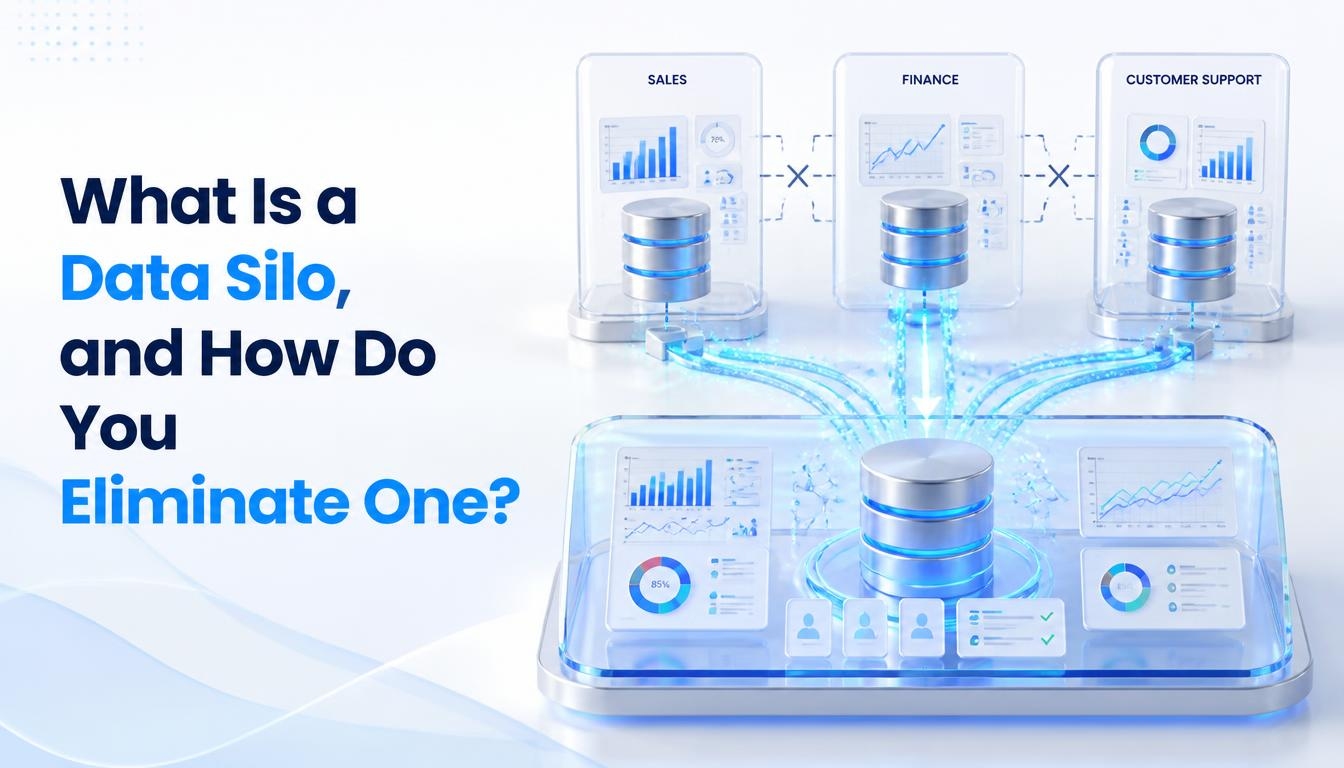
Ask a sales leader how many customers the company has and you may get one number. Ask finance and you may get another. Ask support and you may get a third. When the same question has three answers, the cause is often the same: data is trapped in separate systems that do not talk to each other. This is the data silos business problem, and it quietly slows decisions, inflates costs, and weakens every analytics or AI project built on top of it.
This article explains what a data silo is, what it costs, and how to start breaking down data silos without a massive overhaul.
What Is a Data Silo?
A data silo is a collection of data controlled by one department, system, or team and not easily accessible to the rest of the organization. Think of the CRM only sales can see, the finance system marketing cannot query, or the spreadsheet that lives on one manager is laptop.
Silos rarely appear on purpose. They usually form because of:
• Organizational structure. Departments buy and manage their own tools around their own goals.
• Legacy systems and SaaS sprawl. Older platforms and dozens of cloud apps each store data in their own format.
• Mergers and acquisitions. Combined companies inherit duplicate systems and overlapping records.
• Unclear ownership. No one is responsible for sharing or standardizing data across teams.
• Security and privacy concerns. Teams lock data down because there is no safe way to share it.
Data Silos Business Problem: What Disconnected Data Really Costs
A silo is not just an IT inconvenience. It creates measurable friction across the business:
• Conflicting numbers. Each team reports from its own source, so meetings turn into debates about whose figures are right.
• Duplicated effort. Teams collect, clean, and store the same data more than once.
• Slow decisions. Analysts spend their time stitching data together instead of analyzing it.
• A fragmented customer view. Sales, service, and marketing each see only part of the relationship.
• Higher compliance risk. It is hard to protect or delete personal data when you cannot find it across systems.
• Weaker analytics and AI. Models and dashboards built on partial data give partial answers.
Because these costs are spread across teams, they are easy to overlook, which is why silos can persist for years.
Related reading: [INTERNAL LINK: Pillar post, e.g. What Is Data Governance? A Practical Guide for Analytics Teams]
Breaking Down Data Silos: A Practical Approach
You do not need to fix everything at once. A staged approach works better:
1. Map where data lives. List your systems, spreadsheets, and the people who own them.
2. Prioritize the silos that hurt most. Start with data tied to a visible problem, such as customer or revenue reporting.
3. Agree on shared definitions and owners. Define key metrics once and name someone accountable for each data domain.
4. Connect the data. Choose an integration approach that fits your environment (see below).
5. Set clear access rules. Use role based permissions and privacy controls so sharing is safe as well as easy.
6. Measure and expand. Track results such as fewer conflicting reports and less time to build a new one, then move to the next silo.
Choosing an Integration Approach
Approach | What it does | Good fit |
Data warehouse or lakehouse | Consolidates data from many sources into one governed store. | Organizations that need a shared analytics foundation. |
ETL / ELT pipelines | Moves and transforms data between systems on a schedule or continuously. | Regular reporting and keeping systems in sync. |
Data virtualization | Lets users query multiple sources without copying the data. | Quick access where moving data is impractical. |
Data mesh or data fabric | Connects data across domains using shared standards and metadata instead of a single central store. | Large organizations with many independent data domains. |
No single approach is right for every organization, and many combine two or three.
Keeping Silos From Coming Back
Technology alone will not keep silos away, because new tools and new teams create new ones. Lasting change needs governance: named data owners, shared definitions, and a simple process for approving new data sources. A searchable data catalog helps people find what already exists before they build another copy.
Culture matters just as much. Involve business teams early, reward data sharing, and make it clear that data belongs to the organization, not to a single department.
Next step: [INTERNAL LINK: Sibling cluster post, e.g. how to choose data governance software]
Frequently Asked Questions
What is a data silo in simple terms?
A data silo is a set of data that one department, team, or system controls and that other parts of the organization cannot easily access or combine with their own data. Common examples include a CRM only sales can see or a finance system that other teams cannot query.
What causes data silos?
Data silos usually form when departments choose their own tools, when older systems and cloud apps store data in different formats, when companies merge and inherit duplicate systems, and when no one owns the job of sharing and standardizing data.
Why are data silos a business problem?
Data silos lead to conflicting numbers, duplicated work, slower decisions, and an incomplete view of customers. They also raise compliance risk and limit the quality of analytics and AI projects, because models and reports only see part of the picture.
What is the best way of breaking down data silos?
There is no single best method. Most organizations start by mapping where data lives, prioritizing the silos that cause the most pain, agreeing on shared definitions and owners, and then connecting data through a warehouse, pipelines, virtualization, or a mix of approaches, with clear access rules.
Does a data warehouse or data lake eliminate silos automatically?
No. A central store makes integration possible, but silos can return if teams keep bypassing it or if data is poorly documented and owned. Governance, shared definitions, and a culture of sharing are needed to keep data connected.
Conclusion
Data silos are a business problem long before they are a technical one. They create conflicting numbers, wasted effort, and blind spots that hold back analytics and AI. Start by mapping where your data lives, tackle the silo that causes the most pain, and pair the technology with clear ownership and shared definitions so your data stays connected.
Ready to connect your data? Talk to our team about a practical plan for breaking down silos in your organization. [CTA LINK / CONTACT URL]