.png)
NDMO Data Governance Requirements Explained
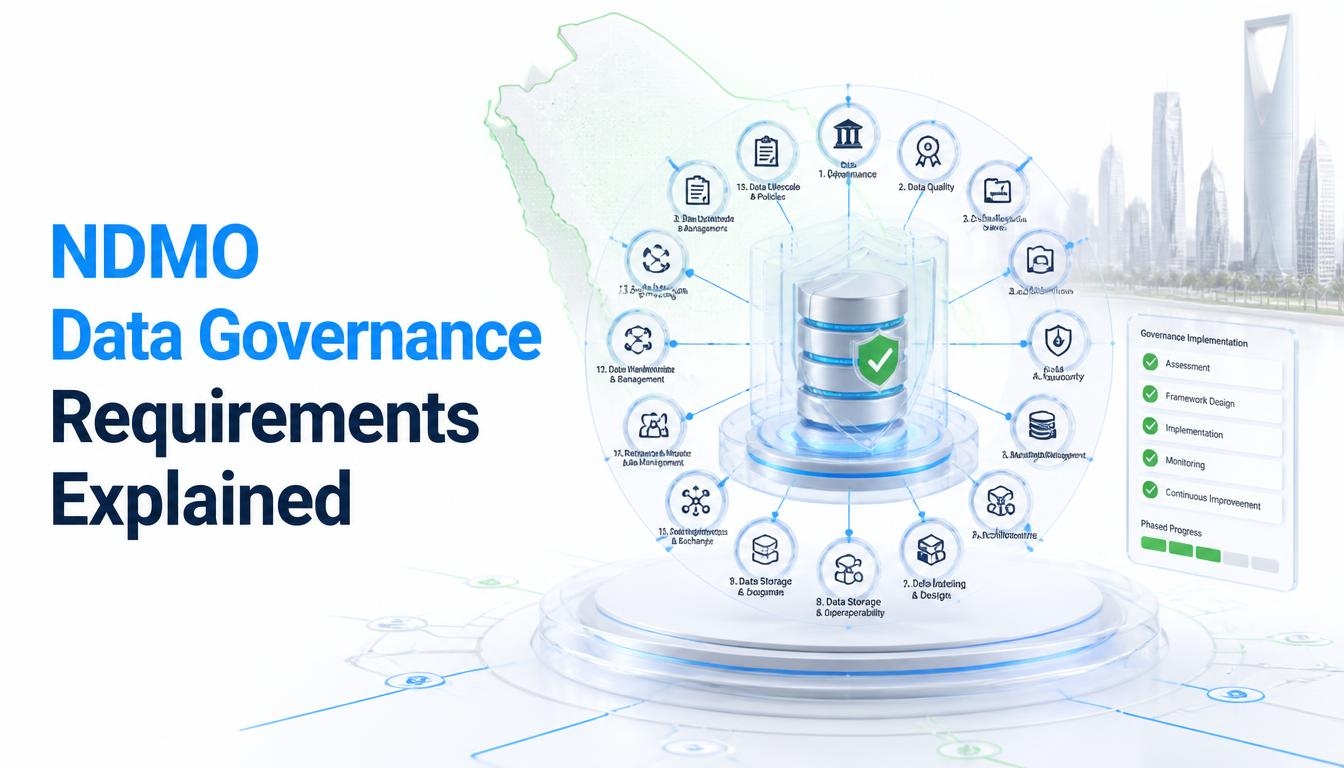
If your organization handles data in the Kingdom, especially government data, the National Data Management Office sets the bar for how it should be governed. The challenge is that NDMO data management requirements span 15 domains and a phased rollout, which is a lot to absorb before you can plan a single project. This guide explains who the NDMO is, what the requirements cover, how the priorities work, and what to look for when choosing data governance software in Saudi Arabia.
What Is the National Data Management Office Saudi Arabia?
The National Data Management Office Saudi Arabia, or NDMO, is the regulatory arm of SDAIA for data governance. A Cabinet resolution directed it to develop and implement policies, governance mechanisms, standards and controls for data and AI, and to monitor compliance. Its main instrument is the Data Management and Personal Data Protection Standards.
The standards are mandatory for public entities and extend to business partners that handle government data. Compliance is measured yearly for government entities. Private companies outside that scope often adopt the standards as a best practice benchmark.
NDMO is standards are also different from the PDPL. The PDPL is a law that applies to every organization processing personal data, while the standards are a governance framework aimed mainly at the public sector. They overlap on personal data protection, so most teams need both in view. For the wider regulatory picture, see our guide to SDAIA compliant analytics.
[INTERNAL LINK to PILLAR: "What Is SDAIA? A Guide to Saudi Arabia's Data & AI Authority" | anchor text: SDAIA compliant analytics]
NDMO Data Management Requirements: The 15 Domains
The standards work as a hierarchy. Each domain contains controls, and each control contains specifications that describe the outputs you must be able to show. Published summaries put the total at 77 controls and 191 specifications across the 15 domains. The table groups the domains by theme.
Group | Domains | What it asks of you |
Governance | 1. Data Governance | Define policies, ownership and accountability for data. |
Data assets | 2. Data Catalog and Metadata; 3. Data Quality; 4. Data Operations; 5. Document and Content Management; 6. Data Architecture and Modelling; 7. Reference and Master Data | Know what data you hold, keep it accurate, and manage it consistently across systems. |
Data usage | 8. Business Intelligence and Analytics; 9. Data Sharing and Interoperability; 10. Data Value Realization; 11. Open Data; 12. Freedom of Information | Use, share and publish data in controlled, well governed ways. |
Classification and privacy | 13. Data Classification; 14. Personal Data Protection | Classify data by sensitivity and protect personal data. |
Protection | 15. Data Security and Protection | Secure data; specifications are defined by the National Cybersecurity Authority. |
The rollout is phased. Specifications fall into three priorities: P1 covers the foundations and comes first, P2 follows, and P3 completes the remainder over roughly three years. Data Governance alone accounts for 18 of the P1 specifications in published breakdowns, so ownership, policies and accountability are the usual starting point. A simple way to begin:
1. Run a gap assessment against the 15 domains to see where you stand.
2. Prioritise P1 specifications and assign a named owner to each.
3. Catalogue and classify your data so you know what you hold and how sensitive it is.
4. Set KPIs and a reporting rhythm so you can show progress over time.
Data Governance Software in Saudi Arabia: What to Look For
No tool makes you compliant on its own. What software does is turn policies into processes you can run and evidence. When comparing data governance software Saudi Arabia teams should check:
• Domain coverage: catalog and metadata, lineage, quality rules and classification that map to the NDMO domains you must evidence.
• Hosting and data residency: where the platform runs and whether data or metadata leaves the Kingdom, since PDPL transfer rules can apply.
• Arabic support: business glossaries and stewardship workflows that work in Arabic as well as English.
• Access control and audit trails: role based permissions and logs that show who accessed and changed what.
• Reporting and integration: progress reporting against specifications, plus connectors to the databases, cloud platforms and BI tools you already use.
Ask vendors to show how specific features map to specific NDMO controls, rather than accepting a general "compliant" label.
[INTERNAL LINK to SIBLING CLUSTER: related post, e.g. PDPL requirements or compliant analytics workflows | anchor text: chosen from that post's target keyword]
Frequently Asked Questions
Who must comply with the NDMO standards?
The standards are mandatory for public entities and extend to business partners that handle government data. Private companies outside that scope often adopt them as a best practice benchmark, while the PDPL applies to all organizations that process personal data.
How many domains, controls and specifications are there?
The Data Management and Personal Data Protection Standards cover 15 domains. Published summaries put the total at 77 controls and 191 specifications, with the specifications for Domain 15, Data Security and Protection, defined by the National Cybersecurity Authority.
What are the P1, P2 and P3 priorities?
Specifications are grouped into three priorities that are phased in over roughly three years. P1 covers the foundational specifications and comes first, P2 follows, and P3 completes the remainder.
Is NDMO the same as the PDPL?
No. The PDPL is a law that applies to all organisations processing personal data, while the NDMO standards are a data governance framework aimed mainly at public entities and their partners. They overlap on personal data protection, so most organisations need both in view.
Do I need data governance software to meet NDMO requirements?
The standards define controls and specifications rather than prescribing particular products. Software is a way to run and evidence those controls, but it does not replace clear policies, named owners and working processes.
Conclusion
NDMO data management requirements can look daunting, but they become manageable once you treat them as 15 domains delivered in phases, starting with governance. Map your gaps, assign owners, and choose tools that help you evidence each control. If you would like help planning your NDMO roadmap, get in touch with our team.