.png)
How SaaS Companies Use AI to Cut Churn Before It Happens
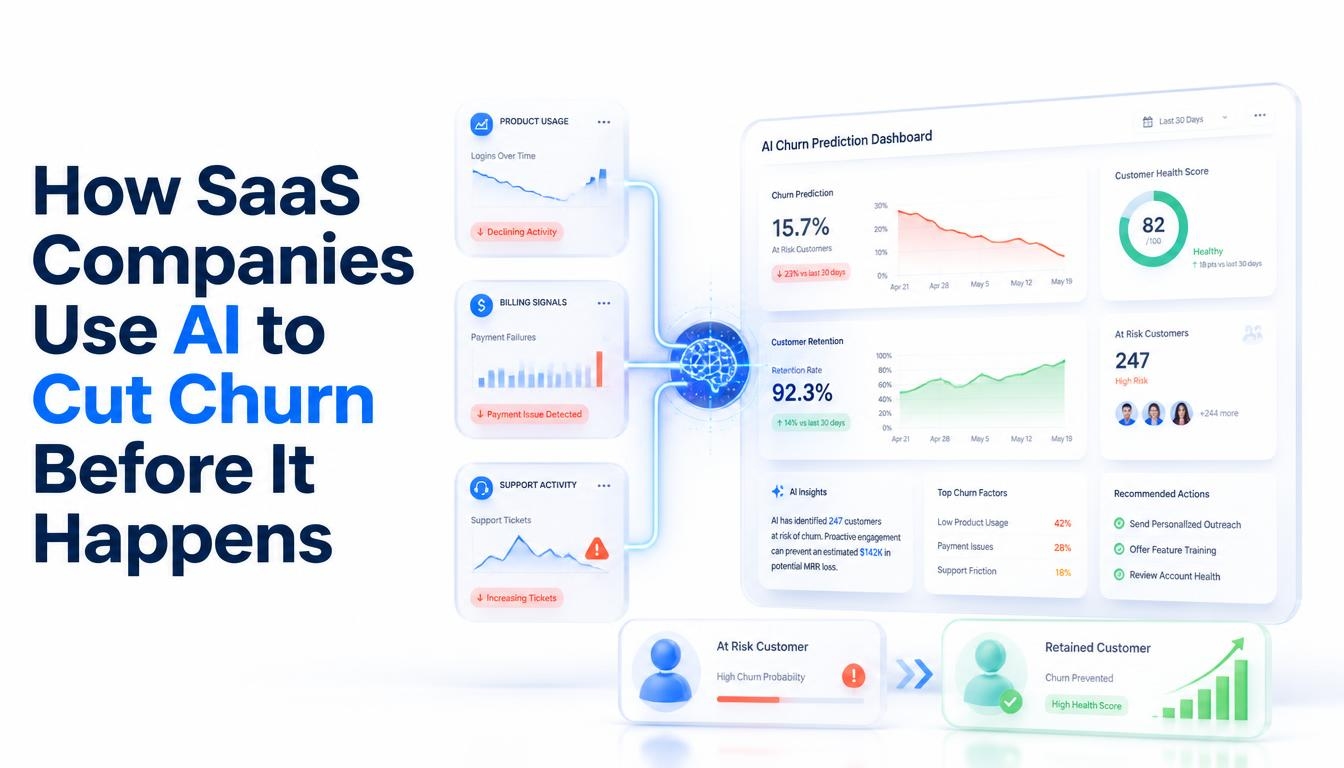
Churn rarely announces itself. An account does not cancel the day it decides to leave it stops logging in three weeks earlier, lets a key integration break, or quietly routes support tickets to a competitor is docs page instead of yours. By the time a cancellation email hits your inbox, the real decision was made a month ago. This is exactly the gap that AI business intelligence for SaaS companies is built to close: turning scattered product, billing, and support signals into a single, live view of which accounts are at risk, and why, while there is still time to act.
Why Churn Is the Silent Killer of SaaS Growth
A few points of churn sound small until they are compounded across years of subscription revenue. A company losing 2% of monthly recurring revenue to churn needs to grow bookings by roughly 24% a year just to stand still, and every dollar spent replacing a lost customer is money not spent acquiring a new one. Traditional churn analysis, a monthly cohort spreadsheet, a quarterly business review tells you what already happened. It cannot tell a customer success manager which of the 400 accounts on their book needs a call this week.
That is the core limitation AI addresses. Instead of static reporting, machine learning models continuously score every account against dozens of behavioral and financial signals, converting a historical report into a forwardlooking, prioritized action list.
What Is AI Business Intelligence for SaaS Companies?
AI business intelligence for SaaS companies refers to analytics platforms that combine traditional BI reporting dashboards, cohorts, revenue breakdowns with machine learning layers that predict outcomes rather than just describing them. Instead of a dashboard that shows last month is logo churn, an AI BI system shows which accounts are likely to churn next month, ranks them by risk and revenue impact, and surfaces the specific usage drop or support pattern driving each score.
Three capabilities separate AI BI from conventional analytics tools:
• Predictive scoring; a churn or health score per account, updated daily rather than reviewed quarterly
• Signal explanation; a plain language reason behind each score, not just a number
• Automated triggers; the ability to kick off an email sequence, Slack alert, or CS task the moment risk crosses a threshold
How Product Usage Analytics AI Reveals Early Churn Signals
Login frequency alone is a weak churn predictor, plenty of healthy accounts check in rarely once a workflow is automated. Product usage analytics ai looks deeper, tracking feature level engagement, workflow completion, seat activation, and time to value against each account is own historical baseline rather than a company wide average.
In practice, the models that perform best watch for combinations of signals rather than any single metric: a drop in a core feature paired with an admin seat going inactive, or a spike in support tickets tagged 'how do I' from an account that used to self serve. Isolated, each signal is noise. Weighted together by a model trained on past churn outcomes, they become a reliable early warning.
Turning SaaS Revenue Analytics into Predictive Retention Models
Usage data explains behavior, but saas revenue analytics adds the financial context that determines how a business should respond. A shrinking seat count on a $2,000 a month enterprise contract deserves a different, faster response than the same pattern on a $49 self serve plan. AI BI platforms merge billing data, contract value, renewal date, payment failures, discount history with usage signals so that risk scores reflect both the likelihood of churn and the revenue at stake.
This is also where expansion and churn analysis converge. The same models that flag risk can flag the opposite: accounts with usage patterns matching past upsells, which is often a more profitable use of the same data pipeline.
Building an AI Driven Churn Prevention Workflow
Getting value from AI business intelligence is not a single tool purchase, it is a workflow that connects data, prediction, and action.
1. Unify the Data
Product events, subscription/billing records, and support tickets need to land in one place, typically a data warehouse with consistent account IDs across systems. This step is unglamorous and usually takes longer than the modeling itself, but a model is only as good as the data feeding it.
2. Score and Explain
A churn or health score model runs against the unified data, producing a risk score per account along with the top factors driving it. Explainability matters here: a score of '72% churn risk' is far less useful to a CS manager than '72% churn risk admin seat inactive 21 days, support tickets up 3x.'
3. Automate the Response
High risk, high value accounts route to a CS manager is queue automatically. Lower value at risk accounts can trigger an automated in app nudge or lifecycle email instead of consuming human time. The goal is matching response effort to revenue at stake.
Choosing the Right AI Business Intelligence Tools for Your SaaS
Most SaaS companies choose between buying a purpose built AI BI platform, building on top of their existing data warehouse, or combining both as the company scales.
Approach | Best For | WatchOut |
Buy an AI BI platform | Teams that need churn scoring live in weeks, not quarters | Less control over the underlying model logic |
Build in house on a data warehouse | Companies with a data science team and unique product signals | Longer time to value; ongoing maintenance cost |
Hybrid (warehouse + AI BI layer) | Midmarket and enterprise SaaS scaling past one product line | Requires clean, unified data pipelines first |
For most teams under a few hundred accounts, a purchased platform reaches value fastest. Larger, data mature organizations often outgrow off the shelf models and shift toward a hybrid setup that keeps proprietary signals in house while using vendor tooling for dashboards and alerting.
Frequently Asked Questions
What is AI business intelligence for SaaS companies?
It is the use of machine learning models layered on top of product, billing, and support data to surface patterns a human analyst would miss, most commonly early churn risk, expansion opportunity, and revenue forecasting, delivered as live dashboards and alerts rather than static reports.
How is this different from traditional SaaS analytics?
Traditional analytics describes what already happened. AI business intelligence adds prediction and prioritization, it scores every account by churn probability and explains which behaviors are driving that score, so teams act before renewal rather than after cancellation.
What data do I need before starting?
At minimum: product usage events, subscription and billing history, and support ticket data, ideally unified in one warehouse. Clean, consistently tracked event data matters more than data volume, a small SaaS with tidy telemetry can build a useful model faster than a large one with fragmented tracking.
Can small SaaS teams use product usage analytics AI without a data science team?
Yes. Most AI BI platforms today ship pre built churn and health score models that only need your product events and billing data connected, no custom modeling required to get a usable first version running.
How accurate are AI churn predictions?
Accuracy depends heavily on data quality and account volume, but mature implementations commonly flag 70 to 85 percent of eventual churners at least 30 days ahead of cancellation, which is enough lead time for a save motion to work.
Does AI replace the customer success team?
No, it redirects their time. Instead of manually reviewing every account, CS teams get a prioritized, explained list of at risk accounts, so human judgment and outreach go where they matter most.
Conclusion: Start Seeing Churn Before It Happens
Churn will always be part of running a SaaS business, but it no longer has to be a surprise. Pairing product usage analytics ai with saas revenue analytics gives teams a live, explained view of risk instead of a postmortem spreadsheet, and that lead time is what turns a churn report into a saved account. If your team is still reacting to cancellations after they happen, the shift to ai business intelligence for SaaS companies is the single highest leverage change you can make to your retention process this quarter.
Ready to see where your churn risk is hiding? Book a walkthrough of your account data and get your first AI generated risk report this week.