.png)
How AI Analytics Platforms Support Vision 2030 Data Goals
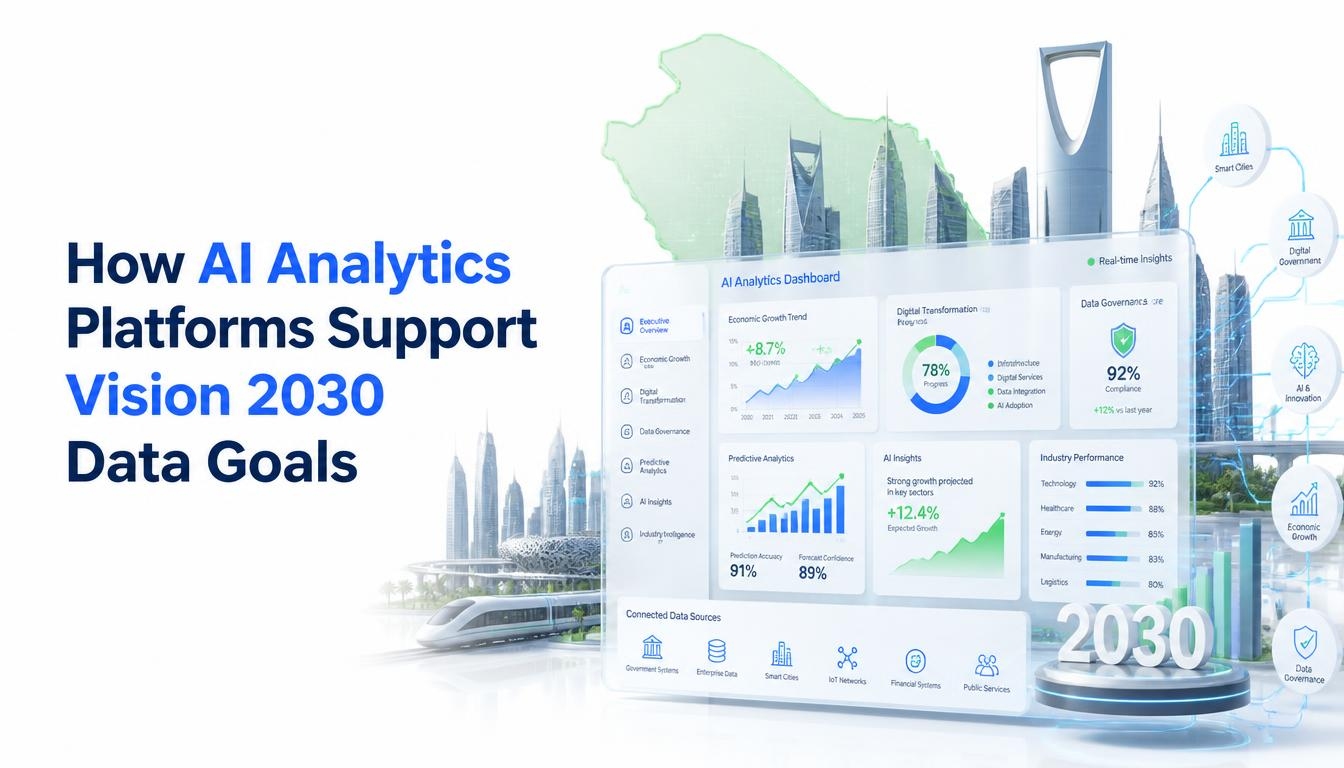
Saudi Arabia no longer treats data as a by product of doing business. Under Vision 2030, it is a national asset, and vision 2030 data analytics is the discipline that turns that asset into better services, smarter investment, and measurable growth. For enterprises operating in the Kingdom, the question has shifted from whether to adopt AI driven analytics to how to do it in a way that fits national priorities on governance, talent, and sector transformation.
This guide explains what Vision 2030 asks of your data, where AI analytics platforms fit, and how to evaluate and roll one out with confidence.
What Vision 2030 Data Goals Mean for Enterprises
The Saudi Data and Artificial Intelligence Authority (SDAIA) was established in 2019 to lead the Kingdom is data and AI agenda. Its National Strategy for Data and AI (NSDAI) sets out targets for 2030 that shape how organizations are expected to work with data:
• Rank among the top 15 countries in AI.
• Develop a pool of 20,000 data and AI specialists and experts.
• Support more than 300 data and AI startups.
• Attract roughly $20 billion (SAR 75 billion) in local and foreign investment.
• Train 40 percent of the workforce in basic data and AI skills.
Alongside these ambitions sits a governance layer. The National Data Management Office (NDMO) sets data policy, and the Personal Data Protection Law (PDPL) has been enforced since September 2023. For enterprises, this means analytics is no longer a purely technical decision. It is tied to compliance, workforce readiness, and national competitiveness.
Related reading: [INTERNAL LINK: cluster post on SDAIA and the National Strategy for Data and AI]
Vision 2030 Data Analytics: Where AI Platforms Fit
Traditional reporting tells you what happened last quarter. AI analytics platforms go further: they connect data from across the business, learn patterns, and surface what is likely to happen next and what to do about it. That shift is what makes them central to vision 2030 data analytics.
From Reporting to Prediction
Machine learning models forecast demand, flag anomalies, and score risk automatically. Instead of waiting for a monthly report, finance, operations, and supply chain teams see emerging issues while there is still time to act.
Arabic and Bilingual Analytics
Much of the region is data, from customer feedback to government correspondence, is in Arabic. Platforms with natural language processing that handles both Arabic and English let teams search, summarize, and query data in the language they actually work in.
Governed, Auditable Data Pipelines
Good platforms treat governance as a built in feature rather than an afterthought. Role based access, lineage tracking, and audit logs make it easier to show regulators and stakeholders where data came from and who used it.
AI Business Intelligence in Riyadh: Why the Capital Sets the Pace
Riyadh is where national strategy meets enterprise execution. SDAIA and many government entities are based in the capital, and the Kingdom is regional headquarters programme has drawn multinational teams to the city. Demand for ai business intelligence in Riyadh is shaped by that concentration of decision makers, regulators, and large enterprises.
What does that look like in practice?
• Executive dashboards that update in near real time, so leadership sees performance across entities and regions without waiting for manual consolidation.
• Natural language querying, so a non technical manager can ask a question in plain language and get a chart back.
• Automated insight alerts, so unusual movements in cost, demand, or service levels reach the right person immediately.
Organizations in the capital also tend to operate at scale, which raises the bar for integration, security, and support. That is why local implementation capability is worth as much as the software itself.
What to Look for in an Enterprise AI Platform in Saudi Arabia
Choosing an enterprise AI platform in Saudi Arabia is different from choosing one in a market with looser data rules or a single dominant language. Use the table below as a starting checklist when comparing vendors.
Criterion | Why it matters | Question to ask the vendor |
Data residency and PDPL alignment | Personal and sensitive data must be handled under Saudi regulations. | Where is data stored and processed, and how do you support PDPL compliance? |
Arabic language support | Arabic text, dialects, and right to left interfaces affect adoption. | How well does your NLP handle Arabic content and Arabic dashboards? |
Integration | Analytics is only useful if it connects to ERP, CRM, and legacy systems. | Which connectors are available, and what does a typical integration involve? |
Explainability | Leaders and regulators need to understand why a model made a recommendation. | Can users see the drivers behind a prediction? |
Scalability and deployment options | Enterprise workloads grow quickly and may need hybrid or on premises setups. | What deployment models do you support, and how do you scale? |
Local support and skills enablement | Workforce readiness is a national priority as well as a project need. | Do you provide onsite support and training for our teams? |
Not sure where to start? [INTERNAL LINK: cluster post on choosing an AI analytics vendor]
AI Analytics Use Cases Across Vision 2030 Priority Sectors
The NSDAI names education, energy, government, healthcare, and mobility as early priorities. Here is how AI analytics platforms can support goals in some of them.
Government Services
Analytics can help agencies monitor service delivery, spot bottlenecks in citizen journeys, and allocate resources based on demand. Consolidated data views also support the transparency and efficiency objectives that run through Vision 2030.
Healthcare
Hospitals and health networks can use predictive models to anticipate patient volumes, manage bed and staff capacity, and track quality indicators, all while keeping sensitive health data tightly governed.
Energy and Industry
Predictive maintenance reduces unplanned downtime, and demand forecasting helps balance production and consumption. Both support efficiency and diversification goals in the broader economy.
Mobility and Logistics
Route optimization, fleet analytics, and demand planning help logistics operators cut costs and improve reliability as the Kingdom builds out its transport and trade infrastructure.
See sector examples in more depth: [INTERNAL LINK: cluster post on AI analytics use cases by sector]
How to Get Started: A Practical Roadmap
1. Define the business questions first. Pick two or three decisions you want to improve, such as demand planning or service response times, before choosing tools.
2. Audit your data. Identify where data lives, who owns it, how clean it is, and which parts fall under PDPL or sector rules.
3. Choose a platform against clear criteria. Use the checklist above and involve IT, compliance, and business users in the evaluation.
4. Run a focused pilot. Start with one use case and a clear success metric, then expand once the value is proven.
5. Invest in people. Train analysts and business users so the platform is actually used. This also supports the national goal of building data and AI skills.
6. Govern and iterate. Review model performance, access rights, and data quality on a regular cadence.
Frequently Asked Questions
What is Vision 2030 data analytics?
Vision 2030 data analytics is the use of data platforms, machine learning, and business intelligence tools to support Saudi Arabia is national transformation goals. It covers how public and private organizations collect, govern, and analyze data to improve services, productivity, and economic diversification.
How is AI business intelligence different from traditional BI?
Traditional BI reports on what already happened through dashboards and scheduled reports. AI business intelligence adds forecasting, anomaly detection, natural language queries, and automated recommendations, so teams can act on what is likely to happen next instead of only reviewing the past.
Do AI analytics platforms have to comply with Saudi data protection rules?
Yes. Organizations processing personal data in the Kingdom need to align with the Personal Data Protection Law, which has been enforced since September 2023, and with data governance policies issued by the National Data Management Office. Platforms should support access controls, audit trails, and data residency options that make compliance easier to demonstrate.
What should an enterprise AI platform in Saudi Arabia support out of the box?
Look for Arabic and English language support, flexible deployment (cloud, hybrid, or on premises), integration with existing ERP and CRM systems, built in governance and audit features, and explainable models. Local implementation support and skills enablement for your team matter as much as the technology itself.
Which sectors benefit most from AI analytics under Vision 2030?
The National Strategy for Data and AI prioritizes education, energy, government, healthcare, and mobility. In practice, any datarich organization, including retail, logistics, finance, and real estate, can benefit from better forecasting, faster reporting, and more efficient operations.
Conclusion
Vision 2030 has made data a strategic priority, and AI analytics platforms are the practical tools that let organizations meet that priority. They move teams from backward looking reports to forward looking decisions, while keeping governance, language, and skills front and center. The organizations that pair the right platform with clear use cases and a trained workforce will be best placed to contribute to, and benefit from, the Kingdom is data driven future.
Ready to put AI analytics to work? Talk to our team about a pilot that fits your data, your sector, and your Vision 2030 goals. [CTA LINK / CONTACT URL]