.png)
What Is the Role of Predictive Analytics in Decision Intelligence?
Explore how predictive analytics powers decision intelligence, from real-time forecasting and AI-driven insights to smarter, faster business decisions.
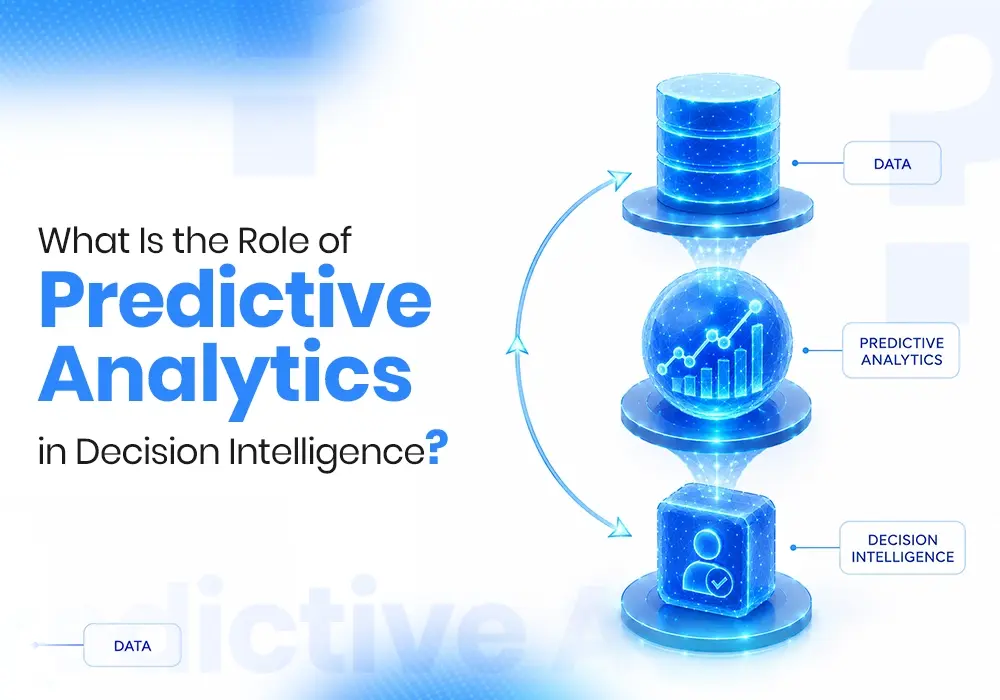
The modern business world has seen information turn out to be a disadvantage in the competition. What really makes a difference is whether the organization can translate the data into effective business decisions. Predictive Analytics in Decision Intelligence comes into play here.
The business environment in which today's enterprises are functioning is extremely fast-changing, has irregular data, high customer demands, and short decision-making cycles. Traditional reports and dashboards are not the answer anymore. In today's organizations, there is a need for a system that will be able to decode history, forecast the future, and recommend the optimal action in real time.
Decision intelligence is a combination of forecasting, AI, and strategic execution. Consequently, businesses are quickly moving towards implementing data-driven decision intelligence systems to boost forecasting, streamline operations, strengthen supply chains, and boost agility. Only 5% of large organizations used formal decision intelligence practices in 2021, with that figure expected to grow to over 33% by 2027, predicts Gartner.
Predictive Analytics In Decision Intelligence Explained
Predictive Analytics in Decision Intelligence is the application of statistical forecasting, machine learning algorithms, and behavioral modeling within intelligent business decisions.
Predictive systems use historical and real-time data to look for patterns, predict outcomes, and make strategic decisions before disruption happens as much as possible, not just looking back at the past and analyzing data.
In real-world business settings, predictive analytics can help businesses respond to key questions like:
Who is most at risk of churning?
What will be the demand trends for the products in the coming quarter?
What are the potential bottlenecks in the operation?
What are the financial risks emerging in business units?
What marketing investments will have the greatest return on investment (ROI)?
What should the dynamic relationship between price and market fluctuation be?
This helps to turn traditional analytics into proactive intelligence.
In an advanced AI decision intelligence ecosystem, forecasts are continually refined with the flowing operational data streams from marketing, finance, logistics, revenue, sales, and IT. The outcome is a single layer of intelligence, which improves the responsiveness and strategic coherence of the organization.
Why Predictive Analytics Is Mission Critical
As more and more data is generated by enterprises, the nature of business decision-making has drastically changed.
According to IDC, the world will generate 180 zettabytes of data by 2028. At the same time, companies that use AI analytics to improve their decision-making can boost their EBITDA by as much as 20%, and cut down on operating inefficiencies by almost 30%, according to McKinsey.
There are still many businesses today that are in silo settings with individuals working with their local data without understanding what is happening in other parts of the business. Marketing tools, CRM systems, ERP systems, supply chain software, and financial dashboards are typically not strategically synchronised.
Predictive analytics overcomes this challenge by synthesising and analyzing cross-functional information to make predictive sense. In today's data-driven decision intelligence systems, organizations benefit:
Unified operational visibility
Forecast-based strategic planning
Risk anticipation capabilities
Real-time anomaly detection
Intelligent automation
Reduced decision-making turnaround time.
In very competitive markets, the capacity to predict results before a competitor can react has a large impact on profitability, retaining customers, and market share growth.
How Predictive Analytics Is Driving Intelligent Decision Making
Predictive analytics is more than just a forecasting spreadsheet or trend report. It's not about its actual value but rather that it allows for scalable, intelligent decision-making of enterprise operations.
1. Forecasting Future Outcomes
Predictive models are based on past patterns to provide statistical forecasts of future scenarios, based on existing variables.
Examples include:
Revenue forecasting
Predicting customer lifetime value
Inventory demand planning
Workforce allocation forecasting
Financial risk analysis
Market trend anticipation
Amazon apparently has these kinds of predictive demand forecasting models that can compare millions of variables daily to ensure optimum placement of inventory in advance of customer purchases.
This prediction capability decreases uncertainty and assists businesses in focusing their resource allocation more effectively.
2. Enabling Real-Time Decision Intelligence
Static reporting cycles are becoming more and more outmoded in today's business environment.
The executives no longer have time to wait for weekly or monthly reports to detect emerging risks. Now, Enterprises need real-time decision intelligence that can interpret operational signals at the speed of light.
Predictive systems that are connected to live data streams from enterprise systems can:
Detect disruption to the supply chain on the spot
Predict the live changes in revenue. Predict the real-time changes in revenue.
Immediate Fraud alerts are sent in real-time.
Increase revenues with optimized dynamic pricing automatically.
Forecast customer churn in real time while engaged in conversation.
The move from reactive management to proactively-driven management translates to better business resiliency.
As an illustration, financial institutions that implemented real-time predictive fraud analytics succeeded in bringing fraud losses on transactions down by over 40%, based on Deloitte research.
3. Enhancing Strategic Precision
Conventional analytics are based on what information—the descriptive information—that has happened.
Predictive analytics goes one step further than this (and decision intelligence comes next) and anticipates what's likely to happen.
This is a large disparity.
When used in conjunction with context-rich business rules, operational constraints, and AI-driven recommendations, predictive insights are truly powerful in complex enterprise ecosystems.
This cross-functional system helps leaders to make faster and more accurate decisions in line with strategy in departments.
This integrated system will help decision makers to make faster and accurate decisions with greater consistency across departments and consistent with the strategic intent.
The Role Of AI In Decision Intelligence
If AI were not involved, predictive analytics would still be subjective and slower. At scale, AI automates model training, anomaly detection, scenario simulation, and recommendation generation.
In an advanced AI decision intelligence system, a company can:
Automate operational recommendations
Test out various business scenarios in a second.
Recognise subconscious patterns of behavior
Optimise workflows autonomously
Minimise human decision fatigue
The productivity and decision optimization gains from AI-powered predictive systems could add up to almost $15.7 trillion in value to the global economy by 2030, according to PwC.
It's a profound strategic shift: Companies are now competing not only on products and services but also on decision quality and decision speed.
A Transition From Analytics To Decision Intelligence
The traditional analytics platforms mainly provide information.
Decision intelligence platforms provide Business Orchestration.
This is the next step in enterprise technology's evolution.
In legacy environments:
Teams examine separate dashboards.
Decision-making remains manual
Often, insights are only received when it is too late.
Cross-functional alignment is not great
Today's decision intelligence ecosystems:
The data sources are consolidated.
Predictive models are updated on a continual basis
AI suggests the best moves to take
Decisions now become context and time specific.
This shift allows businesses to shift from reacting to actions to taking proactive steps.
AI tools such as Fennix. This transformation is demonstrated with a unified decision layer that sits on top of the disjointed enterprise systems. These platforms integrate intelligence into finance, sales, marketing, logistics and supply chain, and IT domains without organizations having to invest in replacing their current operational tools, thus enabling enterprise scale decision optimisation.
Organizations face several challenges, including the need for
Even with all its benefits, there are challenges in putting predictive analytics into practice in decision intelligence systems.
Data Quality Issues
Predictive systems need accurate data to feed them to be accurate. Inaccurate forecasting can be caused by inconsistent, incomplete, and/or fragmented information.
Organizational Silos
Many businesses face issues of fragmented systems and departmental opposition to central intelligence systems.
Explainability and Model Bias
There is a potential for the introduction of biases from the training data into AI models. Clear transparency and understandable AI practices are, therefore, key.
Integration Complexity
Legacy systems make it difficult to introduce enterprise-wide predictive systems.
But, the barriers are increasingly being overcome by low-code integrations, cloud-native architectures, and scalable AI orchestration platforms.
The Future Of Predictive Analytics In Decision Intelligence
Enterprise intelligence of tomorrow will be more autonomous, contextual, and adaptive.
Emerging innovations include:
Systems that use Generative AI to make decisions.
Autonomous operational optimization
Self-learning forecasting models
Real-time digital twins
Hyper-personalized customer intelligence
The ability to coordinate the entire supply chain from the point of view of cognition.
By the end of the next ten years, Gartner estimates that firms that use advanced decision intelligence (DI) will beat their industry rivals by quite a bit on operational efficiency and strategic responsiveness.
Under these circumstances, predictive analytics will no longer be a supporting resource. It will evolve into an institutionalized enterprise skill.
Final Thoughts
The impact of Predictive Analytics on Decision Intelligence is transforming the way enterprises function, compete and grow today.
Collecting data isn't enough for organizations to succeed. From fragmented information to actionable foresight, from intelligent automation to real-time strategic execution, it is becoming more important than ever to transform the way information is viewed and used.
Businesses can move from being "reactive" to being "predictive" with the help of AI, machine learning, forecasting models and enterprise-wide data synchronization.
With this change, businesses can:
Anticipate market shifts
Reduce operational risk
Optimize resource allocation
Improve customer experiences
Accelerate decision velocity
Establish and maintain a competitive edge.
The future of intelligent enterprise transformation in the rapidly changing and complex business landscape will remain solidly in the hands of predictive analytics.
The organizations with the most data will not be the ones who control the future – it will be the ones who can make smarter decisions with the data.
Frequently Asked Questions
What are the benefits of predictive analytics to decision-making?
Predictive analytics leverages past and real-time data to help forecast future trends, risks, and opportunities to inform decisions. It enables businesses to make decisions on the basis of data and not just hunches or reporting after the fact. Predictive forecasting models can assist businesses to utilize resources to their optimal capacity, reduce uncertainty, improve the client experience, and optimizing operations.
What is the difference between predictive analytics and decision intelligence?
The main tenets of predictive analytics are the use of statistical models, machine learning, and patterns of historical data to predict future outcomes. Decision intelligence takes it a step further and combines predictive insights with AI logic, business rules, operations, and recommendations to enable the entire enterprise to be intelligent when making decisions.
What are some of the industries where predictive analytics are used in decision intelligence?
Predictive analytics in decision intelligence is utilized in a variety of industries such as finance, healthcare, retail, e-commerce, manufacturing, logistics, telecom, insurance, and marketing. It is used by organizations for fraud prevention, predicting demand, understanding consumers, streamlining operations, managing risk, and making real-time decisions for strategic plans.
Fennix
Published May 18, 2026
Expert insights on decision intelligence, business analytics, and data-driven leadership from the Fennix team.
Keep reading
All articlesStop Guessing. Start Deciding.
Built for executives who need clear decision support, not data overload.
Start Your 30-Day Pilot